
UPDATED Mailing Tips
NEW information for shipping your cranes
Hello, everyone!
Between tariffs and war, shipping your cranes is an ever-changing art.
The post offices in many countries are currently refusing small packages destined for the USA. Sending cranes in flat envelopes is cheaper and is accepted for most destinations. If you send a box instead of a flat envelope to the USA, your only option will be to use carriers like FedEx or DHL.
Mail to the Middle East is currently disrupted. All connections with participants in that region should be carried out over the Internet.
If the barriers are too high for a regular mail exchange with your chosen exchange partner, an email exchange can be an equally rewarding alternative. Classrooms can also Zoom with one another and make videos to share via links. Getting to the mailing step and realizing the costs are prohibitive is the biggest reason exchanges fall apart. Know your costs upfront, before you agree to an exchange. If costs are too high, please exchange via email.
If you do decide to mail your cranes across borders…
How to Mail Your Peace Cranes
(And How to Keep Postage Low & Avoid Tariffs and Customs Fees)
The short answer is simple:
Mail your crane like a letter, not a package.
Why envelopes matter
Postal systems around the world treat mail very differently depending on whether it is classified as a letter or a package.
Letters:
Cost significantly less to mail
Move faster through the postal system
Usually do not require customs forms
Rarely trigger tariffs, import fees, or inspections
Packages:
Cost more
Are more likely to be delayed
Often require customs declarations
Can trigger tariffs or fees, even for small items
This is why we strongly recommend mailing cranes in standard envelopes, not boxes or padded mailers.
The best way to prepare
To keep your mailing classified as a letter:
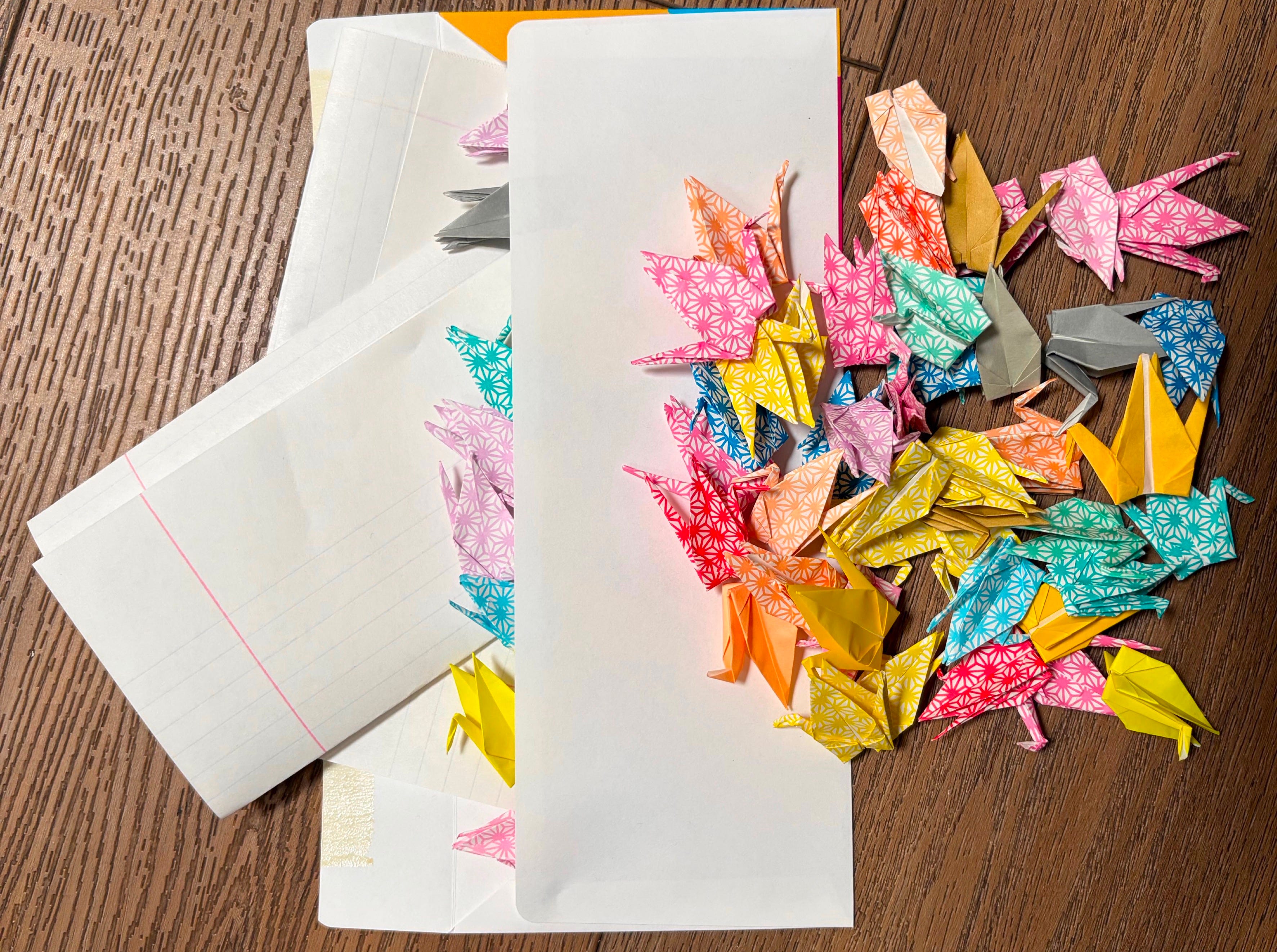
Fold smaller paper cranes
Gently flatten them
Place them in a regular envelope
Include paper only (cranes, drawings, notes)
If you are sending many cranes:
Use multiple envelopes rather than one thick envelope
Keep each envelope under ¼ inch thick
Several thin envelopes mailed as letters are better than one bulky envelope mailed as a package.
We have managed to fit 50 small cranes, plus two letters, into a business-sized envelope. Flattening with a book or heavy object for several days will help you meet the thickness requirement. A stack of small penpal letters can travel in an envelope, as long as its depth does not exceed .25” in the USA (and similar in most of the world). Unfolded, this will probably be up to 50 letters, depending on the thickness of your paper.
Avoid:
Boxes
Bubble or padded envelopes
Rigid inserts
Non-paper objects of any kind
United States (USPS): Letter size & thickness rules
For mail sent from or within the United States, the U.S. Postal Service defines a letter using these criteria:
Size
Minimum: 3.5 × 5 inches (9 × 14 cm)
Maximum: 6⅛ × 11½ inches (15.6 × 29.2 cm)
Thickness
Maximum thickness: ¼ inch (0.635 cm)
Shape & flexibility
Rectangular or square
Flexible (can bend slightly)
No rigid or lumpy contents
Weight
Standard business-sized envelopes can weigh up to 3.5 oz domestically and still require only one Forever Stamp. Extra postage is required if heavier or larger, but will still be classified as a letter.
International letter prices increase by weight, but thin envelopes remain the most economical
More weight = slightly higher postage
More thickness or rigidity = reclassified as a package
Practical test:
If your envelope lies flat on a table and bends easily in your hands — and stays under ¼ inch thick, and 6⅛ × 11½ inches, height and width, (15.6 × 29.2 cm), it will almost always qualify as a letter.
What about other countries?
Postal rules vary slightly from country to country, but most postal services follow Universal Postal Union (UPU)standards.
That means:
Letters are flat
Thin (often 5 mm–6 mm / about ¼ inch)
Flexible
Contain paper only
Examples:
Many countries allow letters that are slightly larger than U.S. limits
Weight steps may be measured in grams (often starting at 20 g)
Thickness rules are usually very similar
Important:
If your envelope meets U.S. letter rules, it will almost always meet letter rules elsewhere.
Customs forms, tariffs, and how to avoid them
Customs forms are typically required when mail is:
Classified as a package
Declared as goods
Bulky or rigid
Assigned a monetary value
To reduce the chance of customs fees or delays:
Mail cranes in thin envelopes
Include paper only
Avoid words like gift, donation, or merchandise
Do not assign a dollar value
If a description of contents is required, use:
“Paper message”
“Origami artwork (paper)”
“Letter / cultural exchange”
Most letter mail does not require a customs form at all.
Sending multiple cranes
If you are sending many cranes:
Use multiple envelopes rather than one thick envelope
Keep each envelope under ¼ inch thick
Two thin envelopes mailed as letters are better than one bulky envelope mailed as a package.
Why we recommend this approach
Our goal is to keep this project:
Affordable for families and classrooms
Accessible across countries and communities
Free from unnecessary fees or delays
Mailing cranes as letters, or exchanging via email, helps ensure that everyone can participate, regardless of location or resources.
Final reminder
Thin. Flat. Flexible. Paper only. Envelope, not a box.
If your mail meets those criteria, you are almost certainly doing it right.
Thank you for taking the extra care to help your crane travel smoothly.
More from our team later this week. Meanwhile, we’re here, looking forward to helping you keep the cranes in flight. Questions? Just ASK.
Happy folding,
The Peace Crane Team